The Hall-Stairs-Landing Job: Flooring a UK Staircase That Takes a Beating

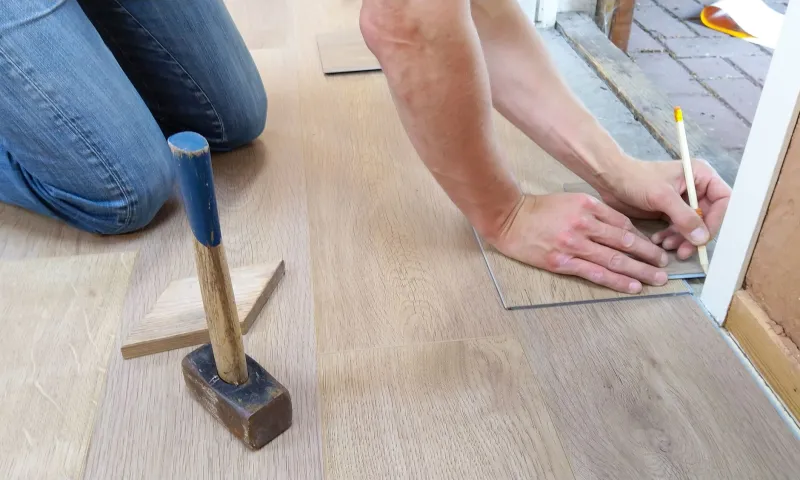
Photo: Walenty Pytel, CC0, via Wikimedia Commons
Stairs are the bit of a flooring project everyone leaves until the last minute. You spend weeks choosing a kitchen floor, then remember the staircase on the Friday before the fitter arrives. That is a mistake, because a typical UK flight is only a couple of square metres of surface but it takes more punishment per square metre than any room in the house. Every trip upstairs is a tiny impact test, and every pair of muddy boots, scrambling dog or socked foot finds the weak spot.
A staircase is not a room. It is a system: treads, risers, nosings, fixings, underlay, and the people using it. Get the system right and it will quietly do its job for years. Get one link wrong and you will hear about it every night.
Start with the household, not the showroom
Before you fall for a herringbone or a deep pile, think about who actually uses the stairs. A household with a dog that scrambles up at speed, children who thump down in socks, or regular muddy-boot traffic needs grip and durability ahead of showroom glamour. A polished engineered board with a micro-bevel looks lovely in a photo; it is less lovely when a lurcher is using it as a launchpad.
The first real decision is carpet runner versus full carpet. A runner is brilliant for a period staircase: it protects the centre of the tread, leaves the edges visible, and can be replaced without redoing the whole flight. But it concentrates wear in the middle and the edges can curl if the gripper work is rushed. Full carpet spreads wear more evenly, but you will see it on the nosings first, because that is where every foot lands.
Carpet, engineered wood or LVT: the honest trade-offs
Carpet is still the quietest, warmest and grippiest option for most UK stairs. Choose a low-pile, tight-loop carpet with a proper action backing, and use a stair-specific underlay rather than a thick leftover roll from the landing. Too much squish underfoot can make a tread feel unstable. Wool mixes are lovely, but they are not magic: a cheap wool carpet on a busy staircase will still wear at the nose.
Engineered wood gives you the period-terrace look, but stairs are not the same as a floor. Each tread is a small floor with a nose, and it needs a solid substrate, proper fixing and a fitter who understands movement. Squeaks usually come from movement between tread and riser, or from loose fixings into the stringer. If you cover that up with a new surface, you have simply bought a more expensive squeak.
LVT is tough, wipeable and good for pets, but not every LVT is rated for stairs. Check the manufacturer's warranty for stair use, the slip rating, and whether it should be glued rather than floated. Glue-down LVT can be noisy on a hollow staircase, and a floating plank on a stair is a trip hazard waiting to happen. Ask for the technical data sheet, not just the display sample.
The weak link is usually the nosing and the fixings
Creaks are the first thing to sort. Screw loose treads back into the stringers, glue squeaky risers, and replace broken brackets before any new covering goes down. At Flooring WM Ltd, we would always rather spend an hour sorting creaks than a day explaining why the new carpet still squeaks.
Stair nosing is where good jobs and bad jobs part company. You can get bullnose, square, overlap and anti-slip insert options, and the right one depends on the covering and the stair. A proud metal nose that catches socks is not a bargain. A colour-matched nosing that is glued and mechanically fixed is worth the extra. On LVT and wood, the nosing also protects the edge of the tread, which is exactly where wear starts.
Slip resistance matters more on stairs than in any room. Socks, dogs, children and wet hands all find polished surfaces. Test a sample with damp hands before you commit, and ask about R10 or R11 ratings for LVT. Carpet has natural grip, but a worn patch at the nose can become slick surprisingly quickly.
Fit the staircase you have, not the one on Pinterest
UK terraces and semis bring their own constraints: narrow flights, winders, half-landings, boxed-in strings, radiator pipes and balustrades that were never designed for a 10mm increase in floor height. Raising the tread surface changes the first and last step, and it can affect door clearance at the top. Check that before you order anything.
Acoustics matter too, especially in a semi or a flat. Stairs transmit impact noise, and a hard surface will make every footstep more noticeable. Carpet and underlay are the obvious fix; if you go for wood or LVT, ask about acoustic underlay and accept that it will not be as quiet as carpet. Removing old gripper rods and staples is also a proper job in itself, so budget for the prep rather than pretending it is included.
Measure twice, brief once
A good staircase brief is short but specific. Count the treads and risers, measure the width, tread depth and riser height, and note any winders or half-landings. Check that the stairs are reasonably consistent; old flights often are not. Confirm the substrate, decide the nosing type, and order around 10% extra for cuts and mistakes. Ask about acclimatisation, disposal of the old covering, and making good afterwards.
A practical checklist before the first tread comes up:
- Walk the stairs with the fitter and point out every creak, loose spindle and uneven tread.
- Confirm the covering is rated for stairs, not just floors.
- Agree the nosing type, colour match and fixing method.
- Check slip rating and underlay or adhesive specification.
- Measure door clearance at the top and bottom of the flight.
- Budget for prep, disposal and making good, not just material and labour.
- Get the quote in writing with the nosing and prep included.
A staircase is only as good as its weakest link. Sort the creaks, specify the nosing properly, choose a covering that suits the household, and brief the fitter before anything is ripped up. Do that, and those thirteen steps will earn their keep without keeping you awake.